Arbrasson
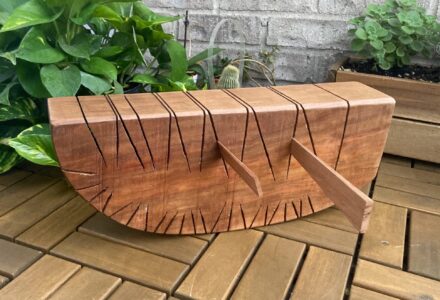








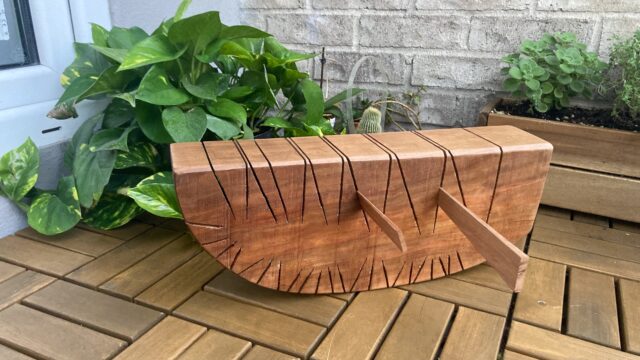
The Arbrasson — aka, the “singing tree”


The Story of the Arbrasson
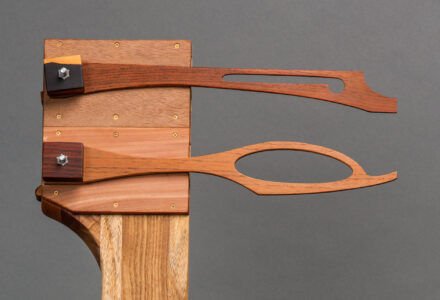
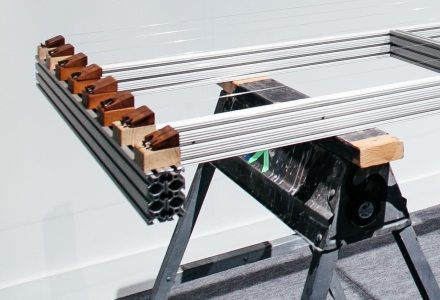
In 2023, I discovered a new instrument called the Arbrasson—a notched wooden instrument that resonates like a singing bird when you caress its carved notches. When people hear it, they usually are surprised by how loud and clear its sound is, which does not seem to match its appearance: it looks like just a piece of wood with mysterious cuts in it—how could it sound like an electronic instrument?
But in fact, this story begins back in 2015. Just before finishing my Master’s at Wesleyan, I am in the studio with my best friend there, the instrument Designer Peter Blasser. He shows me this curious YouTube Video of a skinny French man in the woods rubbing carved logs. The sound captures me immediately, but the visuals confuse me—I hear synthetic, loud, high-pitched sequences of melodic phrases, almost like tape music, but it’s just a piece of wood. It clearly works from friction, but I can’t figure out if it is amplified, or if the blocks are hollow. I can’t tell how old it is—is it ancient? Or something new? It’s in French, a language I don’t know. (I could translate it, but Peter and I end up talking about other things—namely, the possibility of daxophone soundboard that could support two tongues, and I attempt to file this conversation away in my memory somewhere, along with a thousand other instruments I’ve learned and forgotten. Periodically, over the next 8 years, I will remember this instrument occasionally, like a meme, sometimes succeeding and often failing to find the original video. I never learn its name.
8 years later, during a residency in Budapest, I meet a new collaborator, Etienne Rolin, who shares my fascination with invented instruments. He tells me, you must come visit Bordeaux, my friend José Le Piez makes wooden instruments that remind of yours, that sing when you rub them, called Arbrasson. The rest is history: in the summer 2023, I finally meet Jose and play music together, setting up in his hermitage in the woods where he works as a tree surgeon for the most renowned vineyard in Martillac, France.
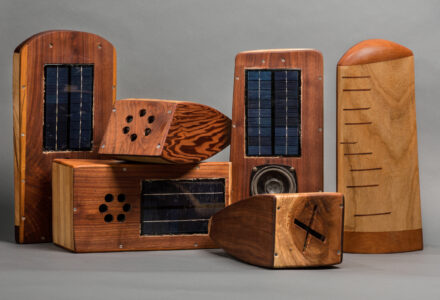
When I returned from France, I began making my own arbrassons—it was not something I learned directly from José—it was just something that made intrinsic sense, based on my long history with Friction Idiophones. In a way, the Arbrasson it is also a relative to my longtime focus, the daxophone. The instruments are inversely related, in way: the daxophone is a sliding pitch instrument like the trombone, capable of making one note in any tuning, whereas the arbrasson is like a piano with its many notes, and can have any number of notes each with a single pitch.
Some Music Made with the Arbrasson
Your Ol’ Toolbox Smells Good
(2024) 04:34
Your Ol’ Toolbox Smells Good is a single from an upcoming album of the same name, made by Daniel Fishkin in collaboration with tape player Aaron Dilloway and Zach Villere.
After taking the time to build my own arbrassons, I had to find a way to record and compose with them that felt original. Unlike the computer, which offers “limitless” manipulation of media, manipulating tape offers a limited palette. But it is physical, tactile—you can pull on the tape, change speeds, cover up the erase head with masking tape, press on the pause button whilst recording. In fact, one of the things that initially drew me to the Arbrasson was that it reminded me of a sped-up tape. On this tape composition, I present the Arbrasson in a new context—in its own jungle, which does not sound like a real jungle that indexes trees and nature. With its mysterious music, buried in tape hiss and distortions, I do not try to say to the audience: “Listen to the arbrasson!”, but rather, to invite the listener to comb through the vines on their own, see what they are able to discover.
Music by Daniel Fishkin and Aaron Dilloway
Music mixing, editing and mastering: Daniel Fishkin & Zack Villere
A movie…about how instruments take us places…
Modos de Transporte: Bois du Rose
(2024) 18:30
Modos de Transporte (in-progress) is a multilingual travel-series. In the episode, “Bois du Rose” the host takes a high speed rail train from Paris to Bordeaux and there discovers the studio of Jose Le Piez, builder of “abrassons,” a type of friction drum sculpted from trees that sings with the simple caress of a hand. In fact, this instrument has a sonic ancestor called the livika, which comes from the island of New Ireland in Papua New Guinea, though there are no remaining indigenous elders trained to play it. As if possessed by these tree sounds, the travelogue dissolves into an abstract film of long takes and slow sounds.
Film by: Daniel Fishkin and Catalina Alvarez
Music: Daniel Fishkin, José Le Piez, and Etienne Rolin
Music editing: Daniel Fishkin
video password: bois
Some Historical Context…
José invented the Arbrasson by accident, while building furniture. He explains that as he began to understand the instrument he had invented, he went to the nearest conservatory to ask if his instrument had any ancestors. Then, he learned about the Livika.Hailing from New Ireland, the Livika is a carved log consisting of three “tongues” that is rubbed by moistened palms to produce a piercing, loud cry. Its name refers to birdcalls, and it was played at Malagan funeral ceremonies. Curator Eric Kjellgren writes, the Livika is “both a first of its type and a revolutionary design” Unlike the jaw harp, which is found all around the world, the Livika is singular to Melanesia. Yet it is considered “extinguished” by the field: there are no practicing indigenous players, and only about 50 known instruments exist in museums around the world. Very few recordings exist of the Livika played in its original context.
Anyway, I’m rambling…Read my dissertation, The Kerf of Sound, for more!
Do you sell Arbrassons?
…NO! I signed an oath and 10 year moratorium with inventor José Le Piez that I shall not make any arbrassons for profit until 2031, nor shall I reveal this instrument’s secrets. Le Piez is a kind of renaissance character, with training as a martial artist, arborist, furniture maker, and magician…and any professional illusionist will tell you, you NEVER reveal their tricks. Similarly, the Livika was always meant to be played hidden from sight— absolutely acousmatic.
HOWEVER, I will take this time to emphasize that I practice a very different school of magic than Le Piez—I believe the magic of music is to be found in the material world and not in the secrets of an informant. If you’ve made it this far, you really need to READ THE KERF OF SOUND to discover the secrets of these Lost Tongues on their own terms.